Nepal has over 400 trekking routes spread across the Himalayas, and every year thousands of first-time trekkers stare at a map wondering: which Nepal trek should I choose? The answer depends on your fitness level, available time, budget, and what kind of experience you want — dramatic high-altitude landscapes, deep cultural immersion, or a gentle walk through rhododendron forests with mountain views.
This guide compares Nepal’s most popular treks head-to-head. Whether you’re a seasoned hiker looking for your next challenge or a complete beginner planning your first Himalayan adventure, you’ll find the right trek here. We’ve included difficulty ratings, costs in both USD and INR, day-by-day durations, and honest opinions on who each trek is actually best for.
Nepal’s Top Treks at a Glance — Comparison Table
Before we break down each trek individually, here’s a quick comparison to help you narrow down your options:
| Trek | Duration | Max Altitude | Difficulty | Best Season | Cost (USD/day) | Best For |
|---|---|---|---|---|---|---|
| Everest Base Camp | 12–14 days | 5,364m | Hard | Oct–Nov, Mar–May | $40–60 | Bucket-list seekers |
| Annapurna Base Camp | 10–12 days | 4,130m | Moderate | Oct–Nov, Mar–Apr | $25–40 | First-timers wanting a classic |
| Annapurna Circuit | 14–18 days | 5,416m | Hard | Oct–Nov, Mar–Apr | $25–35 | Cultural diversity + challenge |
| Poon Hill / Ghorepani | 4–5 days | 3,210m | Easy | Oct–May | $20–30 | Short trips, beginners |
| Langtang Valley | 7–10 days | 3,870m | Moderate | Oct–Nov, Mar–May | $20–30 | Quiet trails near Kathmandu |
| Manaslu Circuit | 14–18 days | 5,106m | Hard | Oct–Nov, Mar–May | $50–70 | Off-the-beaten-path adventure |
| Mardi Himal | 5–7 days | 4,500m | Moderate | Oct–Apr | $20–30 | Solitude + mountain views |
| Upper Mustang | 12–14 days | 3,850m | Moderate | Jun–Sep | $80–120 | Forbidden kingdom, culture |
Choose Your Trek Based on What You Want
Every trekker has different priorities. Here’s a quick decision framework:
Choose Everest Base Camp If You Want the Ultimate Bragging Rights
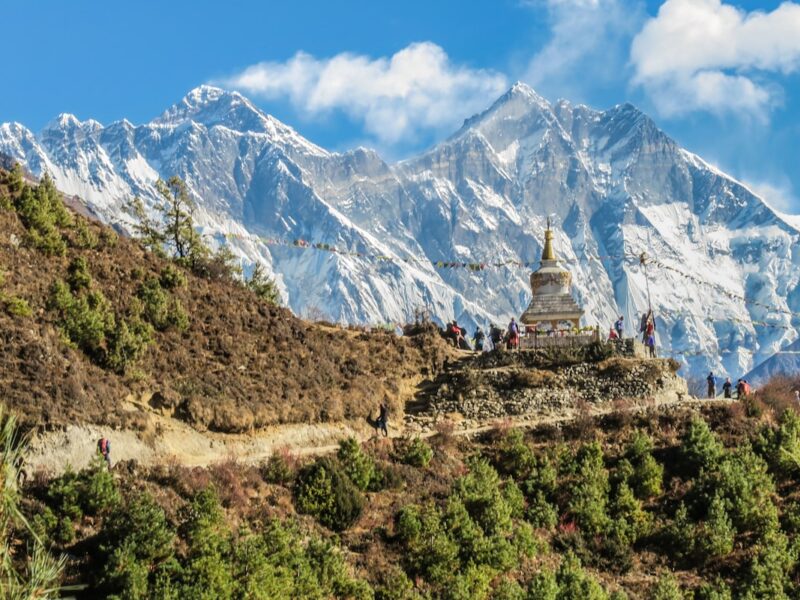
Walking to the foot of the world’s tallest mountain is a once-in-a-lifetime experience. The Everest Base Camp trek takes you through Sherpa villages, past ancient Buddhist monasteries like Tengboche, and right up to the Khumbu Glacier at 5,364 metres. The view from Kala Patthar — Everest, Lhotse, Nuptse, and Ama Dablam all in one frame — is worth every steep step.
You’ll fly into Lukla (one of the world’s most dramatic airport landings), which adds both excitement and cost. Expect to spend around ₹3,500–5,000 per day on food, accommodation, and permits. The total trek including flights, guides, and gear rental comes to roughly $1,200–1,800 (₹1,00,000–1,50,000).
Not ideal if: You have fewer than 12 days, get anxious about altitude, or are on a tight budget. The Lukla flight alone costs ~$165 each way and is weather-dependent — delays of 2–3 days are common during spring.
Choose Annapurna Base Camp If You Want a Classic First Trek
The Annapurna Base Camp (ABC) trek is arguably the best “first serious trek” in Nepal. It delivers everything — rhododendron forests, hot springs at Jhinu Danda, Gurung village homestays, and a jaw-dropping amphitheatre of 8,000-metre peaks — without the extreme altitude of Everest.
Starting from Pokhara (easily reached by bus or short flight from Kathmandu), you’ll spend 10–12 days walking through Nepal’s most diverse landscape. The maximum altitude of 4,130m means altitude sickness is less of a concern, though it can still occur. Budget ₹2,000–3,500 per day; the total trek costs roughly $600–1,000 (₹50,000–84,000) with a guide and porter.
Not ideal if: You want solitude — the ABC trail is busy during peak season. The stone staircases on the descent to Chomrong will test your knees.
Choose Poon Hill If You Have Less Than a Week
The Poon Hill trek packs an incredible amount into just 4–5 days. The 3,210-metre viewpoint offers a 360-degree panorama of Annapurna South, Dhaulagiri, Machhapuchhare (Fishtail), and the entire Annapurna range at sunrise. It’s short enough for travellers with limited time and easy enough for fit beginners.
You’ll walk through Ghorepani village — famous for its rhododendron forests that explode with red, pink, and white blooms in March–April. Tea houses on this route are comfortable and affordable, with rooms at ₹200–500 per night and daal bhaat for ₹400–600. Total cost: $250–400 (₹21,000–34,000).
Not ideal if: You want a challenging multi-week expedition or want to see Everest. This is a taster, not the main course.
Choose Langtang Valley If You Want Mountains Without the Crowds
Langtang is Nepal’s best-kept trekking secret. Just 7–8 hours by bus from Kathmandu (no expensive flights needed), the Langtang Valley trek takes you through Tamang villages, past yak pastures, and up to Kyanjin Gompa at 3,870m — where you can taste fresh yak cheese at the government dairy and climb Kyanjin Ri (4,773m) for panoramic views of Langtang Lirung (7,227m).
The region was devastated by the 2015 earthquake, and trekking here directly supports communities that are still rebuilding. Tea houses are simpler than on the Annapurna or Everest routes, which is part of the charm. Budget ₹1,500–2,500 per day. Total cost: $350–600 (₹29,000–50,000).
Not ideal if: You want luxury tea houses or the bragging rights of reaching 5,000m+.
Choose the Annapurna Circuit If You Want the Greatest Trek on Earth
Many experienced trekkers call the Annapurna Circuit the greatest long-distance trek in the world. Over 14–18 days, you’ll cross the 5,416m Thorung La pass, walk through subtropical rice terraces that transform into arid Tibetan desert, and experience an astonishing cultural gradient — from Hindu Brahmin lowlands through Gurung villages to Tibetan Buddhist communities in Manang.
The circuit starts from Besisahar (accessible by bus from Kathmandu or Pokhara) and typically ends in Jomsom. Road construction has altered parts of the eastern section, so many trekkers now start from Chame or Dharapani to skip the jeep-track sections.
Not ideal if: You have fewer than 14 days or aren’t prepared for extreme altitude. The Thorung La crossing is no joke — blizzards shut the pass several times each season.
Choose the Manaslu Circuit If You Want Adventure Without Tourist Crowds
The Manaslu Circuit is what the Annapurna Circuit was 20 years ago — dramatic, remote, and relatively untouched by mass tourism. Circling the world’s eighth-highest peak (8,156m), this 14–18 day trek passes through the culturally Tibetan Nupri valley, crosses the challenging Larkya La pass (5,106m), and delivers some of Nepal’s most spectacular gorge scenery.
The catch: Manaslu is a restricted area. You need a special permit ($70–100/week depending on season), a registered guide, and a minimum group size of two. These restrictions keep numbers down — which is exactly the point. Total cost: $1,500–2,500 (₹1,25,000–2,10,000) including permit, guide, and porter.
Not ideal if: You’re a solo trekker (group of two required), prefer independent trekking, or want comfortable tea houses. Accommodation is basic and some sections require camping.
Choose Mardi Himal for a Quiet Alternative to ABC
Mardi Himal is the new darling of trekkers who want the Annapurna views without the Annapurna crowds. This 5–7 day trek starts near Pokhara and follows a ridge trail to a high camp at around 4,500m, with Machhapuchhare (Fishtail) looming impossibly close. The trail is quieter than ABC, with fewer tea houses and more genuine encounters with local Gurung families.
The descent follows the same route (no loop option), which some trekkers find repetitive. But the sunrise from High Camp — with Annapurna South, Hiunchuli, and Machhapuchhare catching the first light — makes it worthwhile. Budget similar to Poon Hill: $300–500 (₹25,000–42,000) total.
Choose Upper Mustang If Culture Matters More Than Altitude
Upper Mustang is unlike any other trek in Nepal. Once an independent Tibetan kingdom that was closed to foreigners until 1992, this restricted region feels more like western Tibet than Nepal. The landscape is an arid desert of red and ochre cliffs, wind-carved caves, and ancient walled towns. Lo Manthang, the former capital, still has a king (though his role is now ceremonial).
This is a cultural trek, not an extreme altitude one — the maximum elevation is around 3,850m. But it’s the most expensive trek in Nepal due to the $500 restricted-area permit fee (for the first 10 days). Including permits, guide, and accommodation, budget $2,500–4,000 (₹2,10,000–3,36,000). The best time to go is during the monsoon (June–September), when the rest of Nepal is too wet to trek but Mustang sits in a rain shadow.
How to Choose the Right Trek — A Step-by-Step Decision Process
Still not sure? Walk through these questions:
Step 1: How Many Days Do You Have?
- 3–5 days: Poon Hill, Mardi Himal
- 7–10 days: Langtang Valley, Annapurna Base Camp
- 12–14 days: Everest Base Camp, Upper Mustang
- 14–18+ days: Annapurna Circuit, Manaslu Circuit
Step 2: What’s Your Fitness Level?
- Beginner (active but no trekking experience): Poon Hill, Mardi Himal, Langtang Valley
- Intermediate (regular hiking, can walk 6–8 hours/day): Annapurna Base Camp, Langtang with Kyanjin Ri
- Advanced (experienced trekker, comfortable above 4,000m): Everest Base Camp, Annapurna Circuit, Manaslu Circuit
Step 3: What’s Your Budget?
- Budget (under ₹50,000): Poon Hill, Mardi Himal, Langtang Valley — all accessible by bus from Kathmandu or Pokhara
- Mid-range (₹50,000–1,50,000): Annapurna Base Camp, Everest Base Camp, Annapurna Circuit
- Premium (₹1,50,000+): Manaslu Circuit, Upper Mustang, luxury EBC lodges
Step 4: What Experience Do You Want?
- The iconic photo: Everest Base Camp (Kala Patthar sunrise)
- Cultural immersion: Upper Mustang, Annapurna Circuit, Manaslu
- Mountain amphitheatre: Annapurna Base Camp, Mardi Himal
- Solitude and nature: Langtang Valley, Manaslu Circuit
- Quick but stunning: Poon Hill
Permits You’ll Need for Each Trek
Nepal’s permit system can be confusing, so here’s a clear breakdown. Read the full details in our Nepal trekking permits guide.
| Trek | Permits Required | Cost |
|---|---|---|
| Everest Base Camp | TIMS card + Sagarmatha National Park entry | $20 + NPR 3,000 |
| Annapurna treks (ABC, Circuit, Poon Hill) | TIMS card + ACAP permit | $20 + NPR 2,000 |
| Langtang Valley | TIMS card + Langtang National Park entry | $20 + NPR 3,000 |
| Manaslu Circuit | Restricted area permit + MCAP + ACAP + TIMS | $70–100/week + NPR 2,000 + NPR 2,000 + $20 |
| Upper Mustang | Restricted area permit + ACAP + TIMS | $500/10 days + NPR 2,000 + $20 |
| Mardi Himal | TIMS card + ACAP permit | $20 + NPR 2,000 |
TIMS cards and national park/ACAP permits can be obtained at the Nepal Tourism Board office in Kathmandu (Bhrikuti Mandap) or the tourist office in Pokhara. Bring your passport and two passport-sized photos. Restricted area permits for Manaslu and Upper Mustang must be arranged through a registered trekking agency.
Best Time to Trek in Nepal
The trekking calendar in Nepal revolves around two peak seasons and two off-seasons. For a complete breakdown, see our best time to visit Nepal guide.
Autumn (October–November): The gold standard. Post-monsoon skies are the clearest, temperatures are comfortable, and trails are dry. This is peak season, so popular routes like EBC and ABC will be busy.
Spring (March–May): Second-best window. Rhododendrons bloom at lower elevations (stunning on Poon Hill and ABC), and temperatures warm up. Haze can reduce visibility in lower valleys, but above 3,000m the views are excellent. Late May gets hot at lower elevations.
Winter (December–February): Cold but clear. Lower-altitude treks (Poon Hill, lower Langtang) are doable with proper gear. High passes like Thorung La and Larkya La are often snowed in. Fewer trekkers mean better tea house availability and lower prices.
Monsoon (June–September): Avoid most treks due to rain, leeches, and landslide risk. The exception is Upper Mustang and Dolpo, which sit in the Himalayan rain shadow and are actually best trekked during monsoon.
Essential Gear and Preparation Tips
Regardless of which trek you choose, these fundamentals apply across the board. Check our detailed Nepal packing list for the complete gear breakdown.
Altitude Sickness Prevention
AMS (Acute Mountain Sickness) can affect anyone above 2,500m, regardless of age or fitness. The golden rule: don’t gain more than 300–500m of sleeping altitude per day above 3,000m. Build in acclimatization days — the standard EBC itinerary includes rest days at Namche Bazaar and Dingboche for this reason.
Symptoms start with headache, nausea, and fatigue. If they worsen, descend immediately — this is not optional. The Himalayan Rescue Association runs free altitude sickness lectures at 3 PM daily in Manang (Annapurna Circuit) and Pheriche (Everest region). Attend one.
Guide vs. Solo: What’s Right for You?
Nepal allows independent trekking on most popular routes (EBC, ABC, Poon Hill, Langtang, Mardi Himal). You’ll follow well-marked trails with tea houses every few hours. A guide adds safety at high altitude, helps with language barriers, and supports the local economy — expect to pay $25–35/day for an experienced guide.
For restricted-area treks (Manaslu, Upper Mustang, Dolpo), a registered guide is mandatory and you must trek in a group of at least two. Your trekking agency handles all permits.
Hiring a Porter
Carrying a 12–15 kg pack at 4,000m is no joke. Hiring a porter ($15–20/day) lets you trek with just a daypack. This isn’t luxury — it’s practical, and it directly supports mountain communities. A “porter-guide” ($25–30/day) combines both roles and is the most popular option for solo trekkers and couples.
My Personal Trek Recommendations
After years of guiding clients through Nepal’s mountains, here are my honest picks for different types of trekkers:
For the first-timer from India who has 10 days: Annapurna Base Camp. Fly into Pokhara from Kathmandu (30 min) or take the scenic bus (6–7 hours). The trek is perfectly paced, the cultural experience is rich, and the base camp amphitheatre is genuinely awe-inspiring. You’ll spend ₹50,000–80,000 all-in including guide, porter, permits, and food.
For the fitness enthusiast who wants a challenge: Everest Base Camp. There’s nothing quite like standing at Kala Patthar at sunrise with the entire Khumbu Valley spread below you. Budget 14 days and ₹1,00,000–1,50,000.
For the budget-conscious traveller with less than a week: Poon Hill. Take a bus from Pokhara to Nayapul, trek for 4 days, and catch one of Nepal’s best sunrises. Total cost under ₹25,000 including everything.
For the experienced trekker seeking something different: Manaslu Circuit. This is the trek that veteran Himalayan trekkers rave about. The Larkya La crossing is genuinely challenging, the Nupri valley feels like stepping into Tibet, and you’ll share the trail with a handful of trekkers instead of hundreds.
For couples looking for a romantic trek: Mardi Himal. The ridge-line trail, intimate tea houses, and Machhapuchhare views at sunrise make it Nepal’s most romantic trek. It’s also quiet enough that you’ll feel like you have the mountains to yourselves.
For the culture lover: Upper Mustang. This is less about mountain passes and more about ancient Tibetan monasteries, cave paintings, and a walled medieval city. Nothing else in Nepal comes close to this cultural experience.
Common Mistakes to Avoid When Choosing a Nepal Trek
- Underestimating altitude: A 4,000m trek in Nepal is harder than a 4,000m trek in, say, Ladakh — because Nepal’s trails involve much more vertical gain per day. The ABC trek gains and loses over 2,500m total.
- Choosing only based on Instagram: Everest Base Camp photos look incredible, but the 12-day minimum commitment and high cost aren’t for everyone. Poon Hill and Mardi Himal photograph equally well and take 5 days.
- Skipping acclimatization days: Tour operators sometimes offer “fast” EBC itineraries in 10 days. These exist, but they dramatically increase your risk of serious altitude sickness. Always choose an itinerary with proper rest days.
- Not budgeting for the unexpected: Lukla flights get cancelled, tea houses run out of room during peak season, and gear breaks. Build 2 extra days and $100–200 buffer into your plans.
- Ignoring the monsoon calendar: June–September makes most treks miserable. Exceptions: Upper Mustang and rain-shadow regions. Plan for October–November or March–May.
What to Do After Your Trek
Most trekkers end up in Kathmandu or Pokhara after their trek. Both cities offer excellent post-trek experiences:
In Pokhara: Lakeside relaxation, paragliding from Sarangkot, boating on Phewa Lake, and some of the best massage parlours for sore legs.
In Kathmandu: Explore the UNESCO heritage sites — Boudhanath Stupa, Pashupatinath Temple, and Swayambhunath (Monkey Temple). Thamel is good for a celebration dinner and gear shopping. Read our Kathmandu travel guide for the full breakdown.
If you have extra days, consider adding Chitwan National Park for jungle safaris and rhino spotting — a perfect contrast to the mountains.
Choosing a Nepal trek comes down to knowing yourself — your fitness, your time, your budget, and what makes you come alive in the mountains. There’s no wrong answer. Every trail in the Himalayas delivers something extraordinary. The hardest part isn’t the walking — it’s deciding which trek to do first, knowing you’ll almost certainly come back for another.
Ready to start planning? Browse our complete guide to trekking in Nepal for detailed preparation advice, or get in touch with our trek experts for a personalised recommendation based on your dates and fitness level.